Landmark Judgments That Changed India by Justice Asok Kumar Ganguly
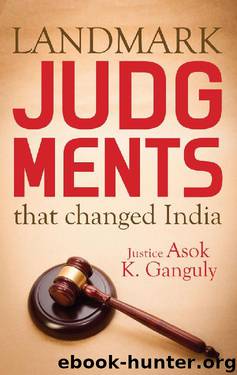
Author:Justice Asok Kumar Ganguly [Ganguly, Justice Asok Kumar]
Language: eng
Format: epub
Tags: Mobilism
Publisher: Rupa Publications
Published: 2015-07-31T18:30:00+00:00
(1)Whether the candidate is convicted/acquitted/discharged of any criminal offence in the past—if any, or whether he is punished with imprisonment or fine.
(2)Prior to six months of filing of nomination, whether the candidate is accused in any pending case of any offence punishable with imprisonment for two years or more, and in which charge is framed or cognizance is taken by the court of law. If so, provide the details thereof.
(3)The assets (immovable, movable, bank balance, etc.) of a candidate and of his/her spouse and that of dependants.
(4)Liabilities, if any, particularly whether there are any overdues of any public financial institution or government dues.
(5)The educational qualifications of the candidate.
This is a path-breaking judgment of the Supreme Court in seeking to streamline the election process, which is crucial in a democracy.
In view of the judgment of the Supreme Court in Union of India v. Association for Democratic Reforms & Another, the Representation of People Act was amended. By way of amendment, Section 33A was added under the caption ‘Right to Information’. Section 33A, which came by way of amendment, did not give full effect to the judgment of the Supreme Court in Union of India. Rather, the amendment gave effect to the same in a truncated manner by providing that the candidate in an election has to furnish information on (1) whether he is accused of any offence punishable with imprisonment for two years or more in a pending case in which charge has been framed by a competent court and (2) whether the candidate has been convicted of any offence other than the offence in sub-sections (1) and (2) of Section 8 of the Representation of People Act and sentenced to imprisonment for one year or more.
Section 33B, which also came by way of the same amendment, on the other hand, imposed a ban on disclosure of any other information despite anything to the contrary in any judgment, decree or order of any court. Challenging Section 33B, as amended, People’s Union for Civil Liberties filed a second case on several grounds in People’s Union for Civil Liberties v. Union of India.17
Dealing with the said challenge, the Supreme Court held that the amendment of Section 33 is ultra vires as it stifles free and fair elections. The three learned judges delivered three separate opinions.
Justice Shah held that the amended Section 33B was beyond the legislative competence of Parliament as in the case of Union of India, the Supreme Court had held that the voter has the fundamental right under Article 19(1)(a) of the Constitution to know the antecedents of a candidate and the said judgment had attained finality. The learned judge held that the voter’s fundamental right to know the antecedents of a candidate was independent of his statutory rights under election laws. The learned judge further held that there is no fixed content on fundamental rights and they are empty vessels, which generations of judges have filled up with their thoughts in the light of their experience and by way of constitutional interpretation.
Download
This site does not store any files on its server. We only index and link to content provided by other sites. Please contact the content providers to delete copyright contents if any and email us, we'll remove relevant links or contents immediately.
The Thirst by Nesbo Jo(6949)
Permanent Record by Edward Snowden(5852)
The Myth of the Strong Leader by Archie Brown(5513)
Spare by Prince Harry The Duke of Sussex(5202)
A Higher Loyalty: Truth, Lies, and Leadership by James Comey(4967)
Secrecy World by Jake Bernstein(4756)
Adulting by Kelly Williams Brown(4582)
The Borden Murders by Sarah Miller(4330)
Machine Learning at Scale with H2O by Gregory Keys | David Whiting(4317)
Killers of the Flower Moon by David Grann(4062)
American Kingpin by Nick Bilton(3894)
The Secret Barrister by The Secret Barrister(3715)
Fear by Bob Woodward(3704)
Future Crimes by Marc Goodman(3603)
The Last Girl by Nadia Murad(3516)
The House on Mango Street by Sandra Cisneros(3475)
Liar's Poker by Michael Lewis(3455)
Oathbringer (The Stormlight Archive, Book 3) by Brandon Sanderson(3225)
The Social Psychology of Inequality by Unknown(3039)
